
Hand Surgery
Preparing For Surgery
- The surgery center will call you the afternoon the day before your surgery for your final arrival time. The anesthesiologist will also call you sometime the day before if you are undergoing any anesthesia.
- Expect to be at the surgery center for several hours.
- At the surgery center, you will change into a gown. Please wear loose fitting clothing that is easy to change in and out of. Please leave valuables and jewelry at home.
- Notify your surgical team of any illness or changes in your health prior to surgery.
Medication
Please address any questions or concerns regarding post-op pain before surgery.
We recommend a multi-modal approach to management of post-op pain:
| Medication | Purpose | How Often |
|---|---|---|
| Acetaminophen | Pain relief | 500-1000mg 3 times/day – Do NOT exceed 3000mg in a 24 hr period |
| Ibuprofen (Advil/Motrin) OR Naproxen (Aleve) | Pain relief / antiinflammatory | If you prefer Ibuprofen
(Advil, Motrin), you can take
400-600mg every 6 hours as
needed (Do not exceed
3200mg per day)
OR If you prefer naproxen (Aleve), you can 220-440mg twice daily. (Do not exceed 1000mg per day) |
Tip: Take medications with food to avoid stomach upset.
- If you were prescribed pain medication, the prescription will be sent to your preferred pharmacy on file ahead of surgery. Please pick up before your date of surgery. Follow instructions on the medication bottle.
General Aftercare
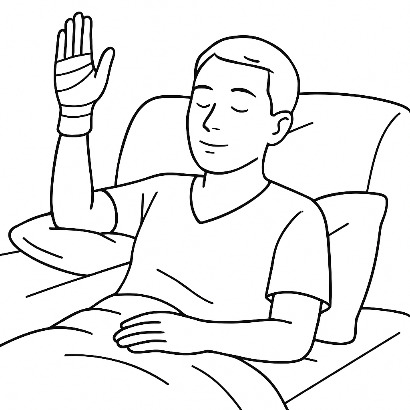
- Mild to moderate swelling and discomfort is normal
-
Your hand and fingers will feel numb/tingly after the procedure due to a long-acting anesthetic
- This can last up to 36 hours
- If your hand is down by your side and begins to feel heavy or start to throb, elevate above heart-level as seen in the graphic to the right
- It is okay to ice your hand. Apply ice for 15 minutes and then allow your hand to warm up fully
- Avoid placing ice directly on the skin
- The surgery center and our oWice will call you after surgery. Please confirm your preferred phone number is on file.
Wound Care
Keep the surgical bandage clean and dry. Do not get wet.
Remove your postoperative bandages:
| Trigger Finger Release Carpal Tunnel Release |
3 days after surgery |
| Cubital Tunnel Release at the elbow Ganglion Cyst Excision Dupuytren’s Release |
5 days after surgery |
| De Quervian’s Release Fracture/ORIF CMC Arthroplasty Wrist Arthroscopy Proximal Row Carpectomy (PRC) |
LEAVE ON UNTIL POST OP APPOINTMENT |
If your procedure is not listed, or you are unsure of when bandages can be removed, please ask before removing.
- After bandages are removed, keep the incision clean and dry. Okay to lightly clean the incision with water and gentle soap, and let water run over the incision. Pat the area dry and cover with band-aid.
- After this initial bandage change, band-aid should be changed daily or as needed
- If there are white adhesive Steri-Strips over the incision, please leave them in place.
- No need to vigorously rub or scrub the incision
- No need to use antibiotic ointment, Vaseline, Aquaphor, hydrogen peroxide, Bacitracin or iodine on the incision
- DO NOT submerge or soak the area/incision (i.e. bath, ocean, swimming pool, jacuzzi)
- DO NOT engage in activities that are sweaty or dirty as this increases your risk for infection
Exercises
- For most procedures it is safe to gently move your fingers while your hand is in the postoperative bandage.
- Unless instructed otherwise, after bandage removal:
- Gentle range of motion to the fingers - opening/closing fist and gentle range of motion of the wrist and elbow.
- AVOID any contact, impact or heavy lifting
Post-op Appointment
- Follow up in the oWice 8-12 days after surgery. Please contact our oWice if you do not have a post-op appointment set up.
Seek Medical Attention
- If you notice bright red bleeding, swelling, coldness, bluish coloring, numbness, persistent pain or sudden intense pain in or around the operative area, or if you have any questions.
- If swelling, redness, heat, and/or drainage occur at the incision site.
- Low grade fever is normal up to 48 hours after surgery. Call for any temperature over 101°.
- Tell your doctor if you cannot urinate 8 to 12 hours after surgery.
- Do Not Drive For 24 Hours Following Surgery.
- You may feel sleepy and somewhat sluggish for several hours.
- Rest today and slowly resume activities tomorrow.
- Do NOT stay by yourself the day of the surgery. If this is not possible, have someone call or visit you frequently.
- Do NOT make any important decisions or participate in activities which require judgment or quick reaction time.
- Do NOT drink alcoholic beverages for 24 hours after surgery and/or when taking pain medications
- *Do Not Drive Or Operate Machinery while Taking Pain Medicine*
You will need the Adobe Reader to view and print these documents.